






Over 10 years we help companies reach their financial and branding goals. Engitech is a values-driven technology agency dedicated.

Gallery

Contacts

411 University St, Seattle, USA

engitech@oceanthemes.net

+1 -800-456-478-23

VDML

Build AI You Can Trust; validated, governed, and ready for real‑world impact.
Streamline your delivery pipeline

Building dependable AI through systematic validation, rigorous risk assessment, and responsible model governance.

VDML Logo

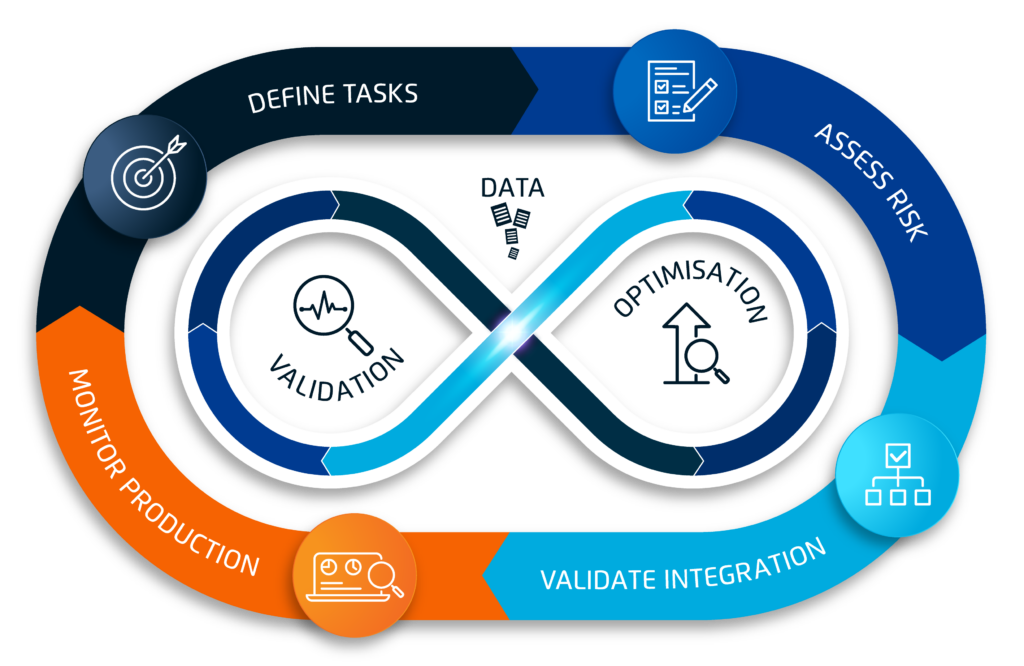
VDML (Validation Driven Machine Learning) is a methodology developed by KJR to guide development of robust and dependable Machine Learning (ML) models. VDML provides a systematic approach to the iterative training and validation process of ML models.

The VDML PROCESS

Methodology

01

Define Task

By clearly defining the benefits the AI-enabled system is expected to deliver, stakeholders develop a clear understanding of the context in which the system is being used. This sets a baseline for assessing risk.
02

Assess Risk

Based on the task, and the relevant legislation and industry compliance requirements that may apply, a risk assessment helps establish the required governance practices that need to be put in place.
03

Resolve Limitations

By selecting test data sets which are close to real world usage, and carrying out detailed error analysis, KJR can help organisations uncover underlying faults and limitations and put appropriate risk mitigations in place.
04

Validate Integration

ML components need to be integrated into a service delivery pipeline which enables appropriate interaction with the host organisation’s data and users.
05

Monitor Production

By helping our clients to track the performance and integrity of their AI-enabled solutions from deployment, operation and maintenance, we can put in place the practical implementation of the governance controls identified as part of the risk assessment process.

VDML and ML System Challenges

Data quality and integrity
ML models rely heavily on data for training and validation but the data may contain errors, biases, or inconsistencies.
Model Performance in Different Contexts
ML models may struggle when faced with different or unseen data, failing to adapt to new scenarios or environments.
Edge Cases and Sparse Data
These cases can be difficult to handle as the model may not have sufficient training examples to make accurate predictions.
Bias and Fairness
ML models can inadvertently learn biases present in the training data. Addressing bias and ensuring fairness in ML models is a critical test in the field.
Interpretability and Transparency
ML models can be complex and difficult to interpret. Understanding why a model makes certain predictions or decisions can be problematic.
Security and Privacy
ML models can be vulnerable to attacks where malicious actors manipulate data. Ensuring the security and privacy of ML systems is an ongoing challenge.

VDML and ML System Challenges

Data quality and integrity
ML models rely heavily on data for training and validation but the data may contain errors, biases, or inconsistencies.
Model Performance in Different Contexts
ML models may struggle when faced with different or unseen data, failing to adapt to new scenarios or environments.
Edge Cases and Sparse Data
These cases can be difficult to handle as the model may not have sufficient training examples to make accurate predictions.
Bias and Fairness
ML models can inadvertently learn biases present in the training data. Addressing bias and ensuring fairness in ML models is a critical test in the field.
Interpretability and Transparency
ML models can be complex and difficult to interpret. Understanding why a model makes certain predictions or decisions can be problematic.
Security and Privacy
ML models can be vulnerable to attacks where malicious actors manipulate data. Ensuring the security and privacy of ML systems is an ongoing challenge.

Customer impact

Across government, healthcare, and enterprise environments, KJR’s VDML approach helps organisations deploy AI systems that perform reliably in high‑risk, data‑sensitive settings. Our clients use VDML to validate models against real‑world conditions, strengthen governance, and ensure their AI behaves as intended, supporting safer decisions, greater compliance, and measurable business value.

Featured case examples

Datarwe NLP


VDML Whitepaper

KJR Chief Technology Officer Dr. Mark Pedersen and Founding Chairman Dr. Kelvin Ross have captured the benefits of VDML in a white paper:

Practical Steps Toward Responsible Governance of AI-Enabled Systems

These key learnings highlight the importance of compliance, governance processes, and a systematic approach like VDML in promoting responsible governance of AI-enabled systems.

By clearly defining the benefits and context in which the AI-enabled system is being used, stakeholders can assess risk and set a baseline for evaluation.


Dr. Kelvin Ross
Chairman
Dr. Mark Pedersen
CTO
KJR Podcast Series

Driving Business Value with AI

In this series, KJR speaks with executive leaders, technologists, and experts at the forefront of trusted AI adoption.

Through real-world examples and deep insights, we explore what it takes to move beyond the hype and implement AI that’s ethical, effective, and enterprise-ready.

Podcast Icon
New Podcast Series

TRUSTED AI ADOPTION

FROM HYPE TO IMPACT

DRIVING BUSINESS VALUE WITH AI

Build AI That Performs When It Matters

Equip your organisation with accurate, well‑governed, and actionable data to drive confident, compliant AI adoption.


Start the conversation using this form

or contact your local KJR General Manager.

Frequently Asked Questions (FAQ)

What is VDML and how does it fit into ML workflows?

VDML integrates directly with ModelOps and DataOps, embedding ML validation into agile, CI/CD, and DevSecOps pipelines. This ensures validation becomes a continuous, automated part of the ML lifecycle rather than a one‑off activity.

What challenges in ML systems does VDML address?

VDML targets systems that rely on machine learning and tackles uncertainties such as data drift, inconsistent behaviour, and domain‑specific performance issues. It provides a structured way to manage these risks across real operational environments.

What are the key stages of the VDML approach?

VDML focuses on three core stages:

  • Understanding context - analysing the data domain and operational environment.
  • Resolving limitations - identifying and addressing model or data weaknesses.
  • Governing behaviour - ensuring the model behaves reliably and aligns with business expectations.
How does VDML improve model performance and business alignment?

Using a data‑centric AI approach, VDML iteratively evaluates models against target data domains. This ensures models achieve the required performance, demonstrate predictable behaviour, and meet business requirements and quality expectations.

How does VDML improve model performance and reliability?

By adopting a data‑centric AI approach, VDML iteratively evaluates model performance against target data domains. This ensures models are not only accurate but also behave consistently under real‑world conditions, meeting business requirements and expected quality characteristics.

Strengthen your AI strategy from every angle

Kelvin Ross Profile Image

Kelvin Ross

– Chairman

The man who started it all – Kelvin John Ross is KJR’s founder. Over 22 years ago, Kelvin had completed his PhD in safety critical systems engineering and was ready to have a crack at the “crazy entrepreneurial ideas” in his head. As the world approached the uncertainty of Y2K, KJR emerged and Kelvin’s life was never the same.


When it comes to KJR, Kelvin believes that “like an artist, the painting is never complete”. He is constantly examining the changing world and working with the Collective to keep KJR relevant and of value to clients. In 2020 alone, Kelvin has been deeply involved in the launch of both Queensland AI Hub – connecting Queensland’s AI ecosystem, and Datarwe – real World Data for AI enabled medical innovation, acting as Director and CTO respectively. And in recent years, Kelvin has helped to set-up IntelliHQ, a non-profit developing the ecosystem for AI innovation in healthcare where he remains a Director, is also a Director at AIkademi (The AI Academy), and co-founded the Young Women Leaders in AI program, which encourages and facilitates the development of Australia’s next generation of brilliant female minds.

Mark Pedersen profile image

Mark Pedersen

– CTO

Mark is an IT professional with a passion for digital culture. During the week, he leads his team at KJR through straight-talking solutions to software problems. In his spare time, he can be found crafting soundscapes and audio/visual installations that embrace technology’s propensity for playfulness and expression.


He first honed his aptitude for software innovation and assurance as a postgrad research assistant at the University of Queensland, where he went on to complete a PhD in Artificial Intelligence, focusing on language technology. It was there he befriended KJR founder Kelvin Ross and they bonded over a shared enthusiasm for fine-tuning software and risk mitigation strategies. He’s been with KJR ever since, taking a few years off to teach IT in the Middle East before returning in 2006 to open the Melbourne branch.


As CTO, Mark’s technical knowledge and lateral thinking abilities are counted on to lead critical software projects safely out of the red and into the light. And, as a world-class software risk analyst and advisor, he thrives on the satisfaction of bettering lives with technology that actually works.


Within the broader industry ecosystem, Mark is a member of the ACS AI in Society Committee, helping to shaping responsible AI usage in Australia, and regularly contributes to international discussion on AI Governance and quality assurance.