







What Quality Engineering Can Teach Us About Trusted AI Adoption | ACS Member Spotlight Interview
Artificial intelligence has moved beyond experimentation and into core business operations: Australian organisations are using AI to automate decisions, improve customer experiences, analyse large datasets, and support critical services across healthcare, government, infrastructure, and financial services. As adoption accelerates, how do we know these systems can be trusted?
Many organisations approach AI governance as something that happens after a solution is built. Policies are drafted, controls are documented, and risks are reviewed before production deployment. While these activities are important, they only address part of the challenge; trust in AI is shaped much earlier. It begins with the quality of the data, the way models are trained and validated, the assumptions made during development, and the processes used to monitor behaviour once systems are operating in the real world.
For teams responsible for software testing, software quality assurance, and digital delivery, this creates a significant opportunity. The disciplines that have helped organisations manage risk in traditional software systems are becoming increasingly relevant to AI-enabled systems.
The Missing Link Between AI Governance and Quality Engineering
One of the reasons AI governance initiatives struggle is that governance and delivery are often treated as separate conversations. Governance frameworks establish principles and controls. Delivery teams focus on building and deploying solutions. The connection between the two is frequently left undefined.
In a recent ACS Member Spotlight, KJR Victoria General Manager Dinuka Mallawaarachchi highlighted the importance of becoming involved earlier in the delivery lifecycle:
I became increasingly driven to get involved earlier in the lifecycle, where the right safeguards, governance, and quality practices can prevent many of the common causes of delay, risk, and costly rework before they emerge.
That observation reflects a challenge many organisations are facing today. Waiting until deployment to assess trust, risk, or compliance often creates expensive remediation efforts. By that stage, the data pipelines, models, integrations, and operational processes are already established. Effective AI governance requires validation activities to be embedded throughout the lifecycle rather than applied at the end.

Validation Matters More Than Good Intentions
Many organisations have published responsible AI principles. Far fewer have established practical mechanisms to validate whether those principles are being achieved. Questions such as these require evidence rather than policy statements:
- Is the model performing consistently across different user groups?
- How does performance change when data characteristics shift?
- What happens when the system encounters unusual scenarios?
- Can decisions be explained and justified?
- Are governance controls operating as intended?
This is where testing AI systems differ from traditional software testing. The objective is not simply to confirm that functionality works. Teams must evaluate behaviour, performance, reliability, fairness, and resilience across a broad range of conditions. Quality engineering provides the structure required to perform these assessments systematically.
A Practical Approach to AI Governance
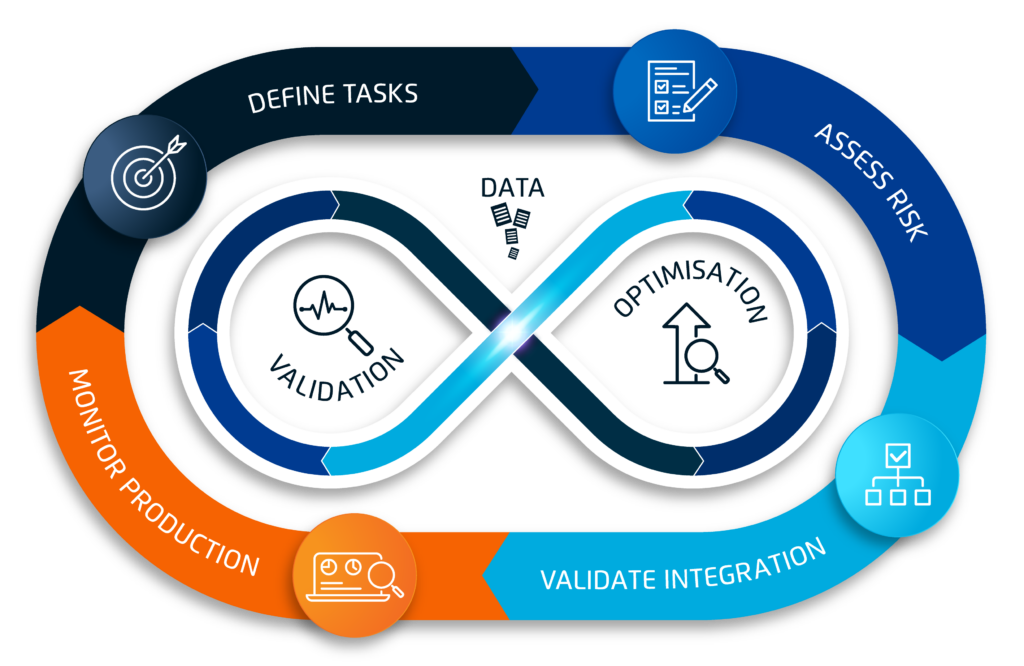
At KJR, this challenge led to the development of Validation Driven Machine Learning (VDML), a methodology designed to support the development and assurance of dependable machine learning systems. Rather than focusing solely on model performance metrics, VDML examines AI-enabled systems through a broader quality and governance lens. The methodology focuses on three critical areas:
- Understanding context
- Resolving limitations
- Governing behaviour
These principles are operationalised through five stages:
- Define the task and intended business outcomes
- Assess risk and compliance obligations
- Resolve limitations through validation and testing
- Validate integration with surrounding systems and processes
- Monitor production performance and governance controls
The goal is straightforward: create confidence that AI systems will behave appropriately within the environments where they operate. This becomes increasingly important as organisations move beyond pilots and begin integrating AI into customer-facing services, operational decision-making, and regulated environments.
What This Looks Like in Practice
The importance of validation becomes clear when AI solutions move into real-world settings.
KJR recently applied its VDML approach to support Datarwe’s healthcare-focused data platform. The objective was to enable AI-driven research while protecting sensitive patient information. Through rigorous validation and testing, the solution achieved greater than 99 per cent accuracy in de-identifying patient data, helping create a secure foundation for data sharing and analysis.
In another engagement, KJR supported a major retail water corporation implementing an AI-enabled IVR platform. The testing program validated transcription accuracy, resilience, and operational performance before deployment, contributing to a successful launch without critical defects.
These projects involved different industries and technologies, yet they shared a common requirement: confidence. The organisations involved needed evidence that systems would perform as expected when exposed to real users, real data, and real operational demands.
Trust Is Earned Through Evidence
As AI adoption grows, the organisations achieving the best outcomes are unlikely to be those deploying models the fastest. They will be the organisations that can demonstrate confidence in their systems, explain how decisions are made, understand their limitations, and respond effectively when conditions change. In the same ACS interview, Dinuka shared a principle that has guided his career:
Growth follows Trust.
For technology leaders, that principle is increasingly relevant. Trust influences customer adoption, regulatory confidence, operational resilience, and the willingness of organisations to scale AI initiatives beyond pilot programs.
It is also something that cannot be achieved through governance documents alone. Trust is built through evidence. It comes from strong data quality practices, disciplined validation, effective testing, transparent governance, and continuous monitoring. These capabilities have long been central to quality engineering. They are now becoming central to successful AI governance as well.
Looking Ahead
AI governance is often discussed as a strategic challenge. In practice, it is also a delivery challenge. The decisions made during development, testing, integration, and deployment directly influence whether an AI-enabled system can be trusted in operation. For quality engineering leaders, test managers, QA professionals, and digital delivery teams, this presents an opportunity to play a more influential role in shaping AI outcomes.
Speak with KJR about how quality engineering, validation, and governance can help your organisation adopt AI with confidence.