






Responsible AI Adoption: How Leaders Drive Real Impact
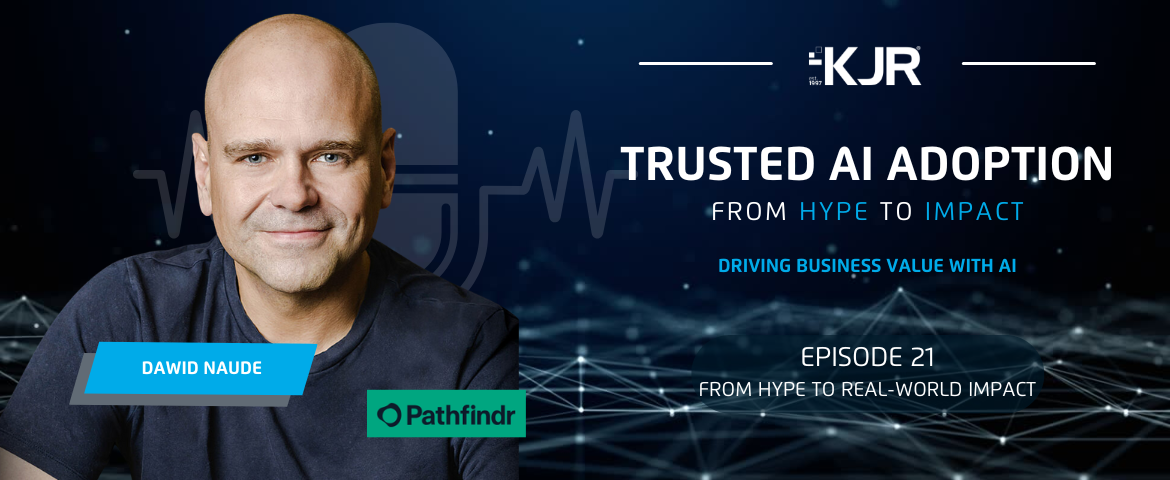
In this episode of Trusted AI: From Hype to Impact, KJR CTO, Dr Mark Pedersen, sits down with Dawid Naude from Pathfindr (part of Affinda Group) to explore one of the biggest challenges facing organisations today: how to move from experimenting with AI to adopting it responsibly, safely, and at scale.
It’s a conversation filled with practical insights, hard-won lessons, and clear direction for leaders who want to get beyond the hype and achieve meaningful outcomes from AI. As the conversation unfolds, two themes emerge: the growing urgency of responsible AI adoption, and the central role of AI leadership in making that happen.
Why Responsible AI Adoption Needs More Than Just Policies
Most organisations today fall into one of two camps:
- AI is “too risky” – so they hold back entirely, or
- AI is “too exciting” – so they push ahead without guardrails.
Neither approach works.
As Dawid points out, governance is not just a document or a policy: it’s an operational capability. And avoiding AI doesn’t eliminate risk. In fact, it creates new ones.
When organisations block tools like ChatGPT at the firewall, staff often resort to their personal devices: snapping photos of screens, pasting sensitive text into external apps, or using consumer AI models with no oversight. The exact risks leaders are trying to prevent are the ones being created.
This is why responsible AI adoption starts by acknowledging reality:
👉 Your employees are already using AI; the question is whether they’re using it responsibly.
Governance must therefore be practical, enabling, and embedded in everyday behaviours. Policies alone can’t achieve that. Leaders need to model the way.
AI Leadership Starts With One Critical Shift: Leaders Must Become Users
A recurring insight from the conversation is that AI adoption only accelerates when leaders actively use AI themselves.
Dawid explains it:
Your leadership team needs to be using AI: not talking about it, not drafting a strategy, but using it.
This is different from traditional technology rollouts. A CEO doesn’t need to use a CRM system personally for it to succeed. But AI is general-purpose. It influences thinking, decision-making, and strategic clarity. Leaders using AI firsthand:
- Understand its real strengths and limitations
- Model responsible usage for the organisation
- Build confidence and trust
- Spot high-value use cases faster
- Remove fear by normalising experimentation
In other words, AI leadership becomes the first step in responsible AI adoption, not the final step.
The Power of Deep Research, Reasoning Models and AI Reflection
One of the most powerful takeaways is how leaders can use AI to improve their own performance. Dawid shares how tools such as GPT-5, Copilot’s Research Agent, Claude and Gemini can:
- Analyse your calendar, emails and work patterns
- Interview you about your priorities
- Reflect inconsistencies between goals and behaviour
- Surface blind spots
- Recommend time-reallocation strategies
- Produce a multi-page “leadership audit”
This is AI leadership in practice: using AI to think more clearly, plan more strategically, and hold up a mirror to your own working habits. It’s not about productivity hacks. It’s about better leadership judgment.
Why AI Pilots Fail, And What Responsible AI Adoption Looks Like Instead
The pattern is predictable:
- A model hallucinated
- The workflow wasn’t reliable enough
- Accuracy drifted after a model update
- Risk concerns emerged
- Nobody felt confident owning it
Responsible AI adoption means recognising that AI is unusual technology. It improves rapidly. It behaves unexpectedly. It changes monthly. It sometimes lies. And traditional engineering assumptions don’t always apply.
Instead of over-engineering early, the conversation highlights a better approach:
No need for a custom model when ChatGPT or Copilot can prove the idea first.
Hand-picked subject-matter experts who explore, test, and refine real workflows.
Within weeks, teams often find 20–40 viable use cases across the business.
Once a workflow is validated, engineering teams can remove risk, automate, and integrate.
This approach builds trust, because it builds evidence.
Practical First Steps for Leaders Ready to Begin
The conversation ends with concrete, actionable steps for anyone wanting to move forward safely and strategically:
1. Conduct a Deep Research Leadership Audi
Ask an AI research agent to interview you, analyse your workload, and produce a reflection on alignment between goals and actions.
2. Commission a Competitive AI Analysis
Understand how your industry is adopting AI, responsibly or otherwise.
3. Use AI Before Every Key Presentation
Ask it: “What hard questions will the board ask me?”
4. Play With AI at Home
Use voice mode, image input, or creative tools to expand your intuition for what’s possible.
These behaviours build confidence, culture and shared understanding, the foundation of responsible AI adoption.
AI Leadership Is Now a Core Competency
Responsible AI adoption isn’t just a technology problem. It’s also a leadership capability.
Leaders who are hands-on with AI – who think with it, test it, critique it and use it to reflect – will guide their organisations safely through uncertainty and unlock the genuine value this technology can provide.
KJR’s expertise in Trusted AI Adoption, AI assurance, governance and validation-driven machine learning complements this journey, helping organisations build AI that is ethical, enterprise-ready and genuinely trustworthy.
Start a conversation with our team about building assured, trusted and enterprise-ready AI.