







Over 10 years we help companies reach their financial and branding goals. Engitech is a values-driven technology agency dedicated.

Gallery

Contacts

411 University St, Seattle, USA

engitech@oceanthemes.net

+1 -800-456-478-23

Article
DevOps Blog Banner

What is DevOps? Everything You Need to Know in One Guide (2026 Edition)
Article
DevOps Blog Banner

DevOps has moved far beyond buzzword status. In 2026, it’s a core delivery capability for Australian organisations navigating complex digital ecosystems, from government programs modernising decades‑old systems to banks streamlining customer onboarding and utilities strengthening critical infrastructure. Speed, stability, and security are no longer negotiable, and DevOps sits at the centre of achieving all three.

Yet despite its ubiquity, DevOps is still widely misunderstood.
Is it a set of tools? A cultural shift? A delivery model?
And how does it meaningfully integrate with Quality Engineering and testing inside large, regulated enterprises?

This guide breaks it down with a practical, practitioner‑focused lens, designed for:

  • Test Analysts
  • Test Managers & Test Leads
  • QA Managers / Heads of Testing
  • Senior Quality Engineering practitioners
  • Technology Directors and CIOs

Whether you’re refining your current DevOps capability or building one from the ground up, this introduction will give you the clarity and context needed to navigate DevOps in real‑world Australian delivery environments.

What Is DevOps?

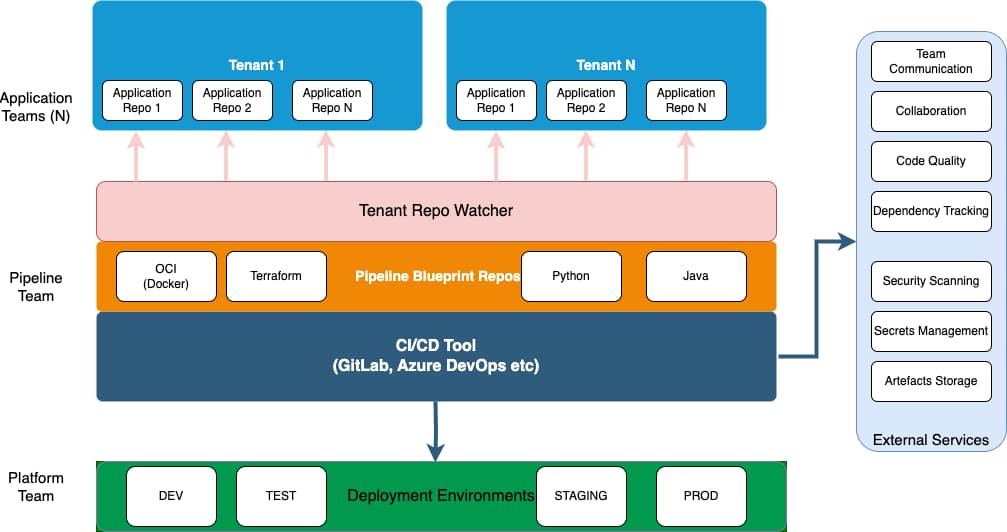
DevOps development infographic

Image source: “Building an Enterprise‑Scale CI/CD Pipeline as a Service” by Faruque Sarker, LinkedIn.

DevOps is a modern delivery approach that integrates software development (Dev) and IT operations (Ops) into a unified, automated, and continuously improving system.

At its core, DevOps is built on:

  • Collaboration between development, testing, operations, and security
  • Automation across build, test, release, and infrastructure
  • Continuous Integration and Continuous Delivery (CI/CD)
  • Measurement and feedback loops
  • Shared accountability for quality and outcomes

However, in enterprise and government contexts across Australia, DevOps services extend beyond culture. They include structured transformation programs, governance frameworks, compliance integration, and measurable performance improvement.

Why DevOps Services Matter in Australia

Australian organisations face:

  • Heightened cyber-security regulations
  • Increased digital service expectations
  • Cloud-first and hybrid infrastructure mandates
  • AI-enabled system integrations
  • Talent shortages in engineering and testing

DevOps services provide a scalable operating model to address these pressures.

In regulated industries such as:

  • Banking & Financial Services
  • Government & Public Sector
  • Energy & Utilities

DevOps services enable faster releases while maintaining compliance, auditability, and resilience.

For QA and testing leaders, DevOps services fundamentally reshape how quality is engineered into delivery.

DevOps vs Agile: What’s the Difference?

Many Australian teams adopt Agile but struggle with delivery bottlenecks. That’s because Agile optimises development cadence, while DevOps services optimise the end-to-end value stream.

Agile

DevOps Services

Focuses on sprint-based development

Focuses on continuous delivery

Improves team collaboration

Improves cross-functional system delivery

Primarily dev-centric

Includes dev, QA, ops, security

Iterative software

Automated deployment pipelines

Agile without DevOps often results in:

  • Manual testing bottlenecks
  • Release weekends
  • Environment instability
  • Delayed production feedback

DevOps services remove these friction points.

At its core, DevOps is about more than speed, it’s about breaking down the long-standing divide between teams that build software and those who run it. When development and operations work in silos, handoffs slow delivery, increase risk, and create misalignment. DevOps addresses this by creating shared ownership, real-time feedback, and continuous collaboration across the lifecycle. How DevOps Improves Collaboration Between Development and Operations explores this in more detail, including how shared pipelines and feedback loops reduce friction and accelerate delivery.

The DevOps Lifecycle Explained

Modern DevOps services operate across an integrated lifecycle:

  • Plan – Backlog refinement and value stream alignment
  • Code – Version-controlled development
  • Build – Automated builds
  • Test – Integrated automated testing
  • Release – Deployment orchestration
  • Deploy – Automated environment promotion
  • Operate – Monitoring and observability
  • Monitor – Feedback into backlog

For QA leaders, the key shift is this:

Testing is no longer a phase. It is embedded across the pipeline.

DevOps Services: What Do They Actually Include?

A mature DevOps consultancy offering DevOps services in Australia typically provides:

1. DevOps Strategy & Advisory

  • Operating model design
  • DevOps maturity assessment
  • Value stream mapping
  • Governance alignment

2. CI/CD Implementation

  • Pipeline architecture
  • Automated test integration
  • Branching strategies
  • Release orchestration

3. Infrastructure as Code (IaC)

  • Cloud-native provisioning
  • Environment consistency
  • Automated configuration management

4. DevSecOps Integration

  • Shift-left security testing
  • Automated vulnerability scanning
  • Compliance automation

5. Quality Engineering Enablement

  • Test automation frameworks
  • Continuous testing strategy
  • Non-functional testing integration
  • Observability-driven quality insights

6. DevOps Transformation Programs

  • Capability uplift
  • Toolchain optimisation
  • Cultural enablement
  • Metrics alignment (DORA, flow metrics) – 

For organisations in Australia, DevOps services increasingly combine DevOps transformation with Quality Engineering excellence, especially in regulated industries.

In practice, this means DevOps is not implemented purely as a delivery acceleration model, but as a quality-first engineering discipline embedded across the entire software lifecycle.

This integration typically involves several key capabilities:

1. Continuous Testing Across the Pipeline

Quality Engineering introduces automated validation at every stage of the CI/CD pipeline. Rather than relying on large regression cycles before release, testing becomes continuous and integrated into build and deployment workflows.

Examples include:

  • Unit and API test automation triggered on every commit
  • Automated regression testing during build stages
  • Performance and security tests embedded into release pipelines
  • Test data management and environment orchestration

This approach allows organisations to maintain high release velocity without compromising reliability.

2. Shift-Left and Shift-Right Quality Practices

Quality Engineering extends testing both earlier and later in the delivery lifecycle.

Shift-left practices include:

  • Test-driven development (TDD)
  • Behaviour-driven development (BDD)
  • Static code analysis
  • Security scanning during development

Shift-right practices include:

  • Production monitoring
  • Synthetic transaction testing
  • Chaos engineering
  • Observability-driven defect detection

Together, these practices create a closed feedback loop between development, operations, and testing teams.

3. Non-Functional Testing Integrated Into DevOps

Regulated industries require robust validation beyond functional correctness.

Quality Engineering integrates automated testing for:

  • Performance and scalability
  • Security vulnerabilities
  • Resilience and failover behaviour
  • Compliance requirements
  • Accessibility standards

Embedding these capabilities into DevOps pipelines ensures that systems meet regulatory and operational requirements before production deployment.

4. Quality Observability and Data-Driven Insights

Modern DevOps environments produce extensive telemetry data across builds, deployments, and production systems.

Quality Engineering uses this data to provide insights such as:

  • Defect escape patterns
  • Performance degradation trends
  • Incident correlation with code changes
  • Test coverage effectiveness

This enables organisations to move from reactive defect detection to predictive quality management.

5. Governance and Compliance Automation

In industries such as banking, government, and utilities, DevOps transformation must align with strict regulatory frameworks.

Quality Engineering ensures DevOps pipelines incorporate:

  • Automated audit trails
  • Compliance validation checkpoints
  • Security policy enforcement
  • Release governance workflows

This allows organisations to achieve continuous delivery without weakening regulatory controls.

How DevOps Services Transform Testing & QA

For Test Managers and QA Leads, DevOps services introduce a significant paradigm shift.

Traditional Model:

  • Testing after development
  • Separate environments
  • Manual regression cycles
  • Release gatekeeping

DevOps-Enabled Model:

  • Continuous testing
  • Automated regression in CI
  • Environment parity through IaC
  • Real-time feedback from production

Key impacts on QA:

  • Test automation becomes mandatory, not optional
  • Non-functional testing shifts left
  • Performance and security testing integrate into pipelines
  • Monitoring data informs future test design

This is where DevOps services delivered by a Quality Engineering specialist create measurable value.

Image Source: Zymr – “DevOps Maturity Model” (2024).

Most Australian organisations fall into one of five maturity stages:

  • Initial – Manual releases, siloed teams
  • Emerging – Basic CI implemented
  • Defined – CI/CD with automated tests
  • Managed – DevSecOps, metrics-driven optimisation
  • Optimised – Full value stream automation and resilience engineering

DevOps services help organisations move deliberately between stages, reducing risk while increasing delivery velocity.

Image Source: Baldani. (n.d.). “Value Stream Management: Software Delivery Visibility and Insight,” CloudBees.

DevOps Metrics That Matter

Modern DevOps services measure performance through:

  • Deployment frequency
  • Lead time for changes
  • Change failure rate
  • Mean time to recovery (MTTR)

These DORA metrics (DevOps Research and Assessment) continue to stand as global benchmarks today.

For QA leaders, additional metrics include:

  • Automated test coverage in pipeline
  • Escaped defect rate
  • Production incident trend analysis
  • Environment drift detection

DevOps services align quality metrics with business performance.

DevOps Services for Key Australian Industries

DevOps services are increasingly adopted across all Australian industries such as Government, Utilities, and Financial Services where continuous delivery, compliance, and system resilience are essential to delivering reliable digital services at scale.

Government & Public Sector

  • Legacy modernisation
  • Citizen-facing digital services
  • Multi-vendor ecosystems

DevOps services support transparency, auditability, and resilience.

Energy & Utilities

  • Critical infrastructure systems
  • Hybrid cloud architecture
  • Operational technology (OT) integration

DevOps services introduce automation while maintaining system stability.

Banking & Financial Services

  • Compliance-heavy release governance
  • High transaction reliability
  • Cyber resilience requirements

DevOps services enable secure continuous delivery without breaching APRA-aligned controls.

Common DevOps Misconceptions

“DevOps is just tooling.”
→ DevOps services address operating models and governance.

“DevOps removes quality gates.”
→ DevOps embeds automated quality controls.

“DevOps eliminates testing roles.”
→ DevOps elevates testing into Quality Engineering.

“DevOps is only for start-ups.”
→ DevOps services are most valuable in complex enterprise environments.

For QA and testing leaders, this transition from phase-based testing to continuous, embedded quality engineering is especially significant. As testing becomes part of the delivery pipeline, collaboration between development, operations, and quality teams becomes non-negotiable. DevOps enables this by aligning teams around shared goals, metrics, and outcomes, ensuring quality is built in, not inspected later. Why Software Quality Assurance Is Critical for DevOps Success dives deeper into how quality engineering strengthens this collaboration and drives better delivery outcomes.

How to Choose the Right DevOps Services Partner in Australia

For Directors, CIOs, and Heads of Testing, consider:

  • Experience in regulated environments
  • Integration with Quality Engineering practices
  • Measurable transformation outcomes
  • Enterprise-scale architecture capability
  • Governance alignment expertise

A DevOps consultancy that combines DevOps services with deep testing and Quality Engineering capability reduces transformation risk.

The Future of DevOps Services (Beyond 2026)

DevOps services are evolving toward:

  • AI-assisted pipeline optimisation
  • Self-healing infrastructure
  • Platform engineering models
  • Resilience engineering
  • Integrated observability ecosystems

For Australian organisations, DevOps services will increasingly integrate with:

  • AI governance frameworks
  • Cyber security maturity uplift
  • Cloud cost optimisation strategies

Final Thoughts: DevOps as a Quality Multiplier

DevOps is not a trend.
It is the operating model for digital delivery in Australia in 2026.

For testing leaders, DevOps services represent an opportunity:

  • To move from reactive defect detection
  • To proactive quality engineering
  • To measurable delivery performance

For CIOs and Directors, DevOps services provide:

  • Faster innovation
  • Reduced release risk
  • Improved system resilience
  • Stronger regulatory alignment

When DevOps services are delivered by a consultancy that understands Quality Engineering and enterprise governance, the result is sustainable transformation, not just pipeline automation.

DevOps isn’t just about moving faster; it’s about delivering with confidence.
If your organisation is ready to embed continuous testing, improve release reliability, and scale delivery securely, KJR can help.

Frequently Asked Questions (FAQs)

DevOps services are structured consulting and implementation offerings that enable organisations to adopt automation, CI/CD, DevSecOps, and continuous testing practices.

No. However, in Australia, DevOps services provide the most measurable impact in complex, regulated, or large-scale delivery environments.

DevOps services embed automated testing into delivery pipelines, integrate quality metrics into operational monitoring, and shift quality left.

Enterprise DevOps services typically operate in phased increments over 6–24 months, depending on maturity.

- Case Studies

picture of pipes
Case Studies

Government owned retail water corporation

A Government owned retail water corporation providing essential services engaged KJR to apply its enterprise software quality engineering expertise to the customer’s Maximo regression testing challenges.

Utility infrastructure image
Case Studies

National Energy Infrastructure Business

A leading energy infrastructure business engaged KJR to develop and execute a set of automated performance tests as part of their Geospatial Information System upgrade project. The customer gained several key benefits including mitigating upgrade risks, insightful analysis, and confident transition to the new platform.

external image of large sandstone building with pillars and dome roof. People walking up and down many steps outside the building entry. Trees and hedges at forefront of image.
Case Studies

Government organisation processing electoral services

A large government organisation that processes electoral services, event and phases identified many optimisations and benefits that could be achieved through the automation of various Electoral Management System workflows.

general picture of a couple of employees looking at a wall full of sticky notes
Case Studies

DevOps in Play

There are many analogies used to describe DevOps, but the simple analogy of “rowing a boat” succinctly captures the reliance that DevOps has on having both the right culture and the right tools.