






Over 10 years we help companies reach their financial and branding goals. Engitech is a values-driven technology agency dedicated.

Gallery

Contacts

411 University St, Seattle, USA

engitech@oceanthemes.net

+1 -800-456-478-23

Article
What Local Governments Must Know About AI Governance blog Banner

From Hype to Impact: What Local Governments Must Know About AI Governance

Article
What Local Governments Must Know About AI Governance blog Banner

Artificial intelligence is rapidly moving from experimentation to real-world impact across the public sector. From infrastructure monitoring to waste management optimisation, AI is beginning to shape how local governments deliver services and manage assets.

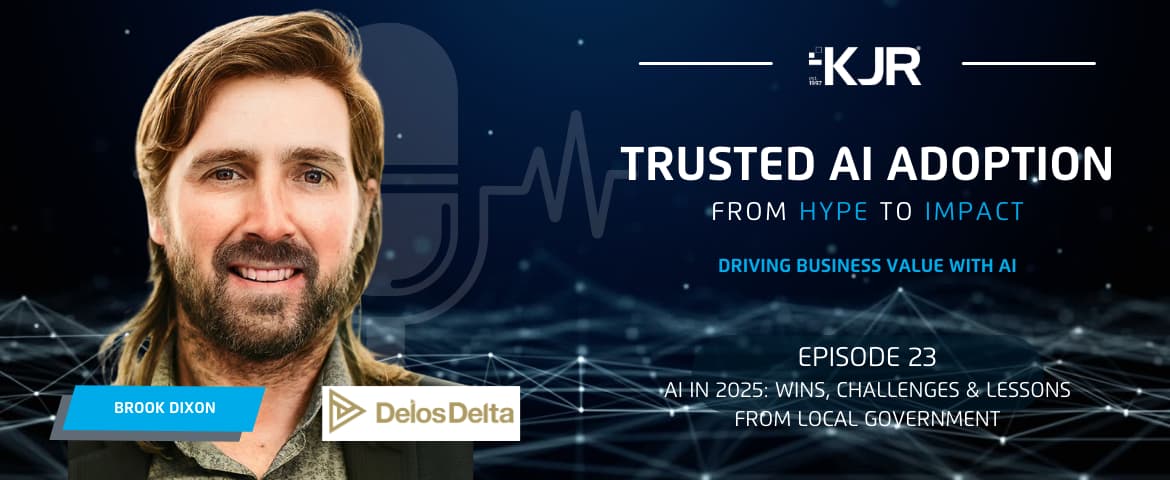
In a recent episode of the Trusted AI Adoption: From Hype to Impact series, Andrew Hammond, General Manager of KJR ACT, sat down with Brook Dixon, Group CEO of Delos Delta, to reflect on the lessons learned from AI adoption by government agencies in 2025.

Drawing on Delos Delta’s extensive work with Australian councils and government agencies, Brook shared practical insights into how AI is being implemented on the ground, the governance gaps many organisations are still addressing, and why transparency and responsible adoption are becoming increasingly important.

Their discussion highlights a key message for government leaders: AI is no longer a future concept, it is already embedded in operational systems. The challenge now is ensuring that adoption happens in a way that balances innovation with effective governance and risk management.

Andrew Hammond
General Manager ACT & NSW

AI Adoption in Local Government Is Accelerating

Across Australia, artificial intelligence is becoming increasingly integrated into local government operations. What once existed as isolated experimentation is now moving into mainstream organisational practice.

In earlier stages of adoption, many AI initiatives were happening informally within small teams. Today, however, organisations are beginning to bring these initiatives into formal governance and strategy frameworks.

Several shifts are now becoming visible across the public sector:

  • AI initiatives are no longer operating beneath the surface
  • Executive leadership is becoming more actively involved
  • AI systems are increasingly integrated into policy and governance structures

This transition marks an important turning point. AI is moving beyond experimentation and becoming part of the operational backbone of modern government services.

Why AI Governance Matters for Local Governments

One of the most striking observations raised was that many local government entities were slower than expected to introduce formal AI governance frameworks.

This does not necessarily reflect resistance to the technology. Rather, the speed at which AI tools have appeared across operational environments has made governance difficult to keep pace.

It is emphasised that AI introduces both opportunity and uncertainty. While many risks are already visible, others may only emerge as adoption scales.

For this reason, delaying governance until systems are fully mature can create unnecessary exposure to operational or reputational risks.

Instead, a pragmatic approach is recommended:

  • Establish a targeted AI governance framework early
  • Test how it works in practice
  • Refine and improve it as AI capabilities evolve

This iterative model allows councils to innovate while maintaining appropriate oversight.

Balancing Innovation with Risk Management

Local governments operate in environments where public trust, accountability, and service reliability are essential.

Organisations often fall into two opposing approaches when adopting new technologies. Some become overly cautious and slow innovation. Others move quickly in pursuit of efficiency gains without fully considering governance implications.

Governance should not be seen as a barrier to innovation. Rather, it acts as a safeguard that ensures organisations remain “on the road and on the tracks” while adopting new technologies.

Without appropriate oversight, AI systems may produce incorrect outputs or unintended consequences. In the public sector, these issues can quickly become highly visible.

Building governance and risk management into AI initiatives from the outset helps organisations innovate responsibly while maintaining public trust.

Without appropriate oversight, AI systems may produce incorrect outputs or unintended consequences. In many cases, this can occur as models evolve and their performance changes over time, a phenomenon known as AI model drift. Learn more about how organisations manage this challenge in our guide on AI Model Drift Explained: How Assurance Helps Maintain Accuracy Over Time.

Real AI Use Cases Emerging in Local Councils

“AI is intrinsically a great detector of bureaucracy and poor process.” - Brook Dixon (Group CEO of Delos Delta)

While governance challenges remain, many councils are already seeing meaningful value from AI in operational environments.

Here are several practical examples where artificial intelligence is helping local governments analyse large volumes of data and improve decision-making:

Waste Management and Recycling Compliance

Some councils are using AI-powered systems to analyse waste collection data and determine whether residents are disposing of materials correctly.

Because recycling rules change frequently, these systems help identify non-compliance more efficiently and support improved waste management outcomes.

Infrastructure Monitoring

AI is also being used to analyse video footage from underground stormwater systems and pipelines.

By processing inspection footage automatically, councils can identify maintenance issues earlier and prioritise repairs before problems escalate.

Road Condition Monitoring

Another emerging application involves analysing footage collected from council vehicles.

AI systems can process this visual data to identify road deterioration and infrastructure issues, helping councils prioritise maintenance based on real operational insights.

In each of these cases, AI is helping governments transform raw data into actionable intelligence.

AI Is Becoming Part of the Government Operating Model

Another significant shift identified is how AI is gradually becoming embedded within organisational structures rather than operating as a side experiment.

In earlier stages of adoption, AI projects were often led by small groups of innovators exploring new possibilities.

Today, executive leaders are increasingly integrating AI into broader organisational frameworks by:

  • Aligning AI initiatives with strategic priorities
  • Embedding AI considerations within policy and governance structures
  • Increasing transparency and accountability around AI use

While this approach may introduce additional oversight and structure, it also brings clear benefits:

  • Greater organisational support
  • Improved transparency
  • Stronger accountability mechanisms

For public sector organisations managing essential services, this structured approach is often necessary for responsible adoption.

Transparency and Disclosure Will Become More Important

Looking ahead, transparency will become an increasingly important aspect of AI adoption.

As AI becomes more common in decision-making processes, organisations may need to be more open about how these systems are being used.

In some cases, AI-generated content or analysis may influence decisions without being clearly disclosed. Increasing transparency around AI usage could help maintain public trust while enabling organisations to continue benefiting from the technology.

For governments in particular, clear disclosure and responsible use will likely become central to maintaining legitimacy and accountability in an AI-enabled world.

Moving from AI Hype to Responsible Adoption

Artificial intelligence offers significant potential for improving public services, infrastructure management, and operational efficiency within local government.

However, successful adoption requires more than simply deploying new tools.

Responsible AI adoption requires:

  • Clear governance frameworks
  • Active risk management
  • Transparency and disclosure
  • Collaboration between technology, policy, and operational leaders

By embedding these principles early, local governments can move beyond the hype and begin delivering real, trusted impact from AI.

Build Trusted AI with KJR

As artificial intelligence becomes embedded across public sector systems, governments must ensure that innovation is supported by strong governance, risk management, and accountability.

At KJR, we work with government organisations to help them move from AI experimentation to trusted, responsible adoption. Our specialists support agencies in designing governance frameworks, validating AI-enabled systems, and ensuring that new technologies deliver real value while maintaining public trust.

Through our Trusted AI Adoption services, we help organisations:

  • Establish practical AI governance frameworks
  • Assess and manage AI-related risks
  • Validate and test AI-enabled systems
  • Align AI initiatives with regulatory and policy requirements
  • Ensure transparency, reliability, and accountability in AI adoption

If your organisation is exploring how to implement AI responsibly, learn more about our approach to Trusted AI Adoption and how we help government agencies turn AI potential into trusted outcomes.

AI adoption in government is accelerating, but successful implementation requires strong governance, risk management, and transparency.
Contact KJR today to learn how our Trusted AI specialists can help your organisation move from experimentation to responsible, real-world impact.

Frequently Asked Questions (FAQs)

AI governance services provide frameworks, policies, and oversight mechanisms that guide how AI technologies are adopted and used responsibly.

For local governments, governance helps ensure that AI systems operate safely, ethically, and in alignment with public expectations. Without clear governance, organisations risk introducing systems that may produce unreliable outcomes or create reputational challenges.

AI is increasingly being applied in operational environments where large volumes of data must be analysed quickly.

Examples include:

  • Monitoring recycling compliance through waste collection data
  • Inspecting stormwater systems using video analysis
  • Analysing road conditions using footage from council vehicles

These applications help councils make better infrastructure and service delivery decisions.

Without governance frameworks in place, AI initiatives may introduce risks such as:

  • Incorrect or biased decision-making
  • Operational failures or system inaccuracies
  • Public trust issues if AI usage is not transparent

Governance helps organisations identify, manage, and mitigate these risks before they escalate.

A practical starting point is to introduce a targeted governance framework early and refine it over time.

Rather than waiting for perfect policies, organisations can:

  • Establish initial governance guidelines
  • Pilot AI initiatives under controlled conditions
  • Adjust frameworks as experience grows

This approach enables innovation while maintaining oversight.

As AI systems influence decisions affecting communities and public services, transparency becomes critical.

Being open about how AI is used helps maintain public trust and ensures that technology is deployed responsibly.

AI is gradually becoming embedded within government operating models.

Instead of existing as isolated experiments, AI initiatives are increasingly being integrated into strategic planning, governance frameworks, and service delivery processes.

This shift is turning AI into a core capability for modern public sector organisations.

For government leaders, responsible AI adoption requires more than deploying technology.

Key priorities should include:

  • Ensuring AI systems are properly tested and validated before deployment
  • Embedding governance and risk management frameworks early
  • Establishing transparency around where and how AI is used
  • Aligning AI initiatives with organisational strategy and public value

When these principles are applied effectively, AI can enhance decision-making and service delivery while maintaining the accountability and trust expected in the public sector.

- Case Studies

close up of monitor in hospital room showing line graph on the screen
Case Studies

Datarwe NLP

Read how KJR built and validated a custom NLP pipeline using its Validation Driven Machine Learning (VDML) approach to achieve >99% accuracy in de-identifying patient data, enabling secure, scalable, and compliant AI-driven data sharing.

The image shows multiple water meters and associated plumbing
Case Studies

Large Victorian Water Utility

This long-term Victorian Utilities client wanted to unify all
its disparate data sources and integrate with cloud data sources. KJR was required to assist with an AI risk analysis and to conduct
thorough testing of data and transformations.

site mapping picture
Case Studies

World-Heritage Rock Art

Thanks to drone, artificial intelligence (AI) and mapping technology carried out by KJR and partners, world-heritage Aboriginal rock art dating back thousands of years is one step closer to being re-discovered for the first time.

Andrew Profile Picture

Andrew Hammond

– General Manager ACT & NSW

A self-proclaimed ‘technology addict’, Andrew (or Drew) has been at the helm of KJR’s ACT operations since 2009. From two people to over 30 consultants today, the Canberra office has soared under his guidance serving multiple Federal government clients and branching into the broader set of KJR services over the past few years. Not one to miss out, Andrew takes a hands-on approach with projects, keeping his carefully-honed skills polished and at the ready.
 
Andrew’s other passion is sport. Whether it’s ‘netball dad’ duties or riding his bicycle around Australia in the TourXOz for a fantastic cause, he’s the embodiment of a man on a mission. And when work and sport collide, Andrew creates an iOS app to improve the experience for supporters of multiple netball teams.